Every photograph is a decision about what future generations inherit
A portrait
Most of us never meet our great grandparents. We know them only through what remains. A handful of photographs. Stories repeated across generations. Recipes prepared without written instructions. Letters tucked into drawers. Names recorded in family Bibles. Together, these fragments become the evidence from which we imagine the people whose lives made our own possible. Long before we study history, we inherit it in this form.
This inheritance is always incomplete. No photograph can preserve a person's voice, their convictions or the countless ordinary decisions that shaped a lifetime. Stories change with each telling. Memories soften with time. Objects gradually lose the context that once gave them meaning. Together, however, they allow people we have never met to remain present in our lives. We inherit not the past itself, but the traces it leaves behind.
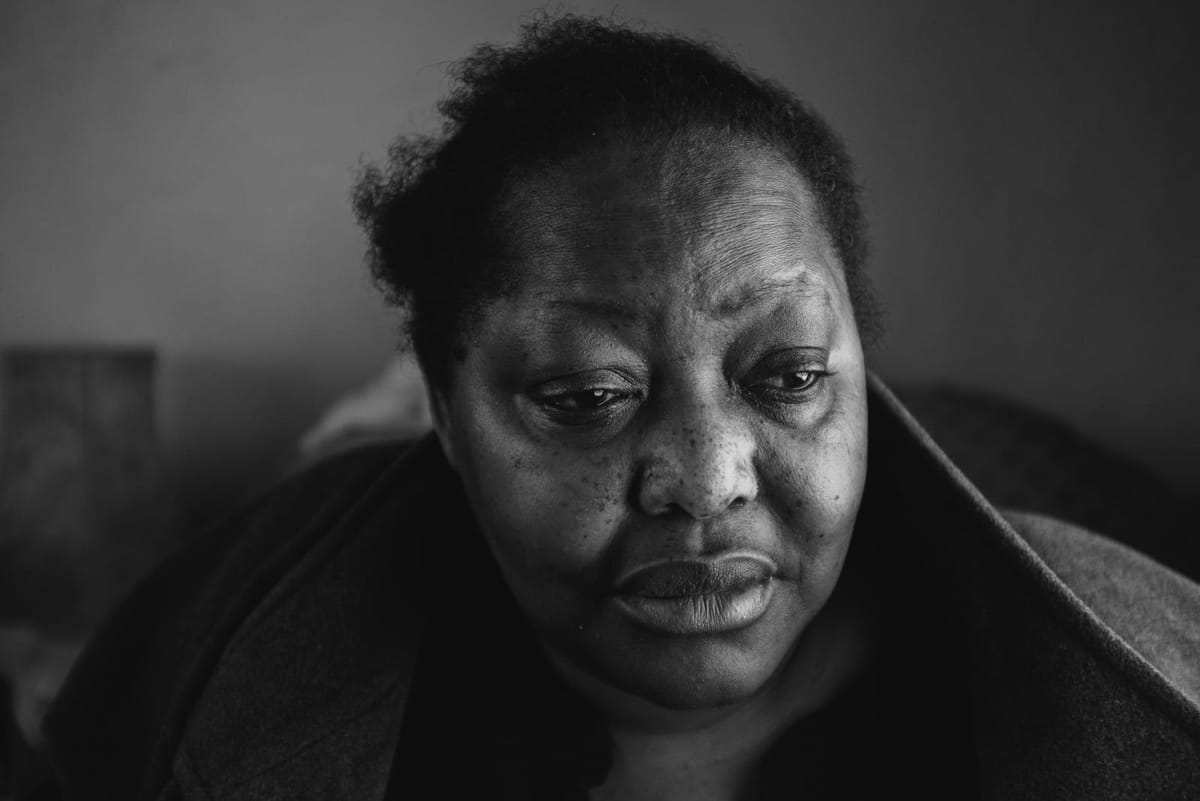
This is one of the last portraits I made of my mother.
By the time I raised the camera, illness had already begun to narrow her world. After spending most of her working life in the NHS, she had been forced to retire through ill health. In her final role, she cared for newborn babies, guided by a simple belief that shaped both her work and her understanding of the world. Every child deserved a good start in life.
What the photograph offers is the opportunity to encounter her. Wrapped in her go to jacket, she looks beyond the camera, her attention resting somewhere outside the frame. The light falls gently across her face, revealing neither strength nor vulnerability as fixed qualities, but the accumulated experience of a life already largely lived. The portrait neither dramatises her illness nor attempts to conceal it. It asks us to look carefully.
Someone encountering this photograph for the first time would know almost nothing about the woman before them. They would not know that she belonged to the generation of Caribbean migrants who helped rebuild Britain's public services after the Second World War. They would not know that colleagues relied upon her judgement during the most demanding moments of her career, or that she understood nursing as an act of service rather than simply a profession. They would not know the warmth of the kitchen where our family gathered, the certainty of her faith or the quiet confidence with which she encouraged those around her. Those things survive because they continue to be remembered. The photograph preserves the possibility that someone who never knew her might still wonder who she was.
One day, my grandchildren may know their great grandmother only through what remains. They will inherit this portrait alongside family stories, recipes, letters and the poem I wrote after her death. None of these things will be complete on their own. Together, they may allow someone who never met her to begin imagining the life behind the photograph.
The longer I have lived with this portrait, the more it has shaped the way I think about photography. Photographs outlive the moments that produced them. They become part of the inheritance through which later generations try to understand people they never knew. That realisation has changed the questions I ask before making every photograph.
What we actually inherit
Every life eventually becomes an archive. However full a life may be, what survives is always selective. A few photographs. Official documents. Family stories. Cherished objects whose significance may be obvious to one generation and mysterious to the next. No archive is complete because no life can ever be reduced to the things that remain after it has ended.
Every family understands this instinctively. We do not keep photographs because they tell us everything about the people we love. We keep them because they allow us to begin remembering. A photograph prompts another story, another question or another memory. Someone recalls where it was taken. Someone else remembers who stood just outside the frame. A child asks about a face they have never seen before. The photograph becomes a place where memory continues its work.
The same is true beyond the family. Communities inherit more than buildings and institutions. They inherit traditions, recipes, songs, places of worship, ways of speaking and ways of caring for one another. Much of this inheritance passes from one generation to the next without anyone noticing it. Only when something begins to disappear do we realise how much it shaped our understanding of who we are.
Photography occupies a unique place within that inheritance because it preserves something no other record can. It allows us to encounter another person's presence across time. We recognise a face, a posture, an expression or a gesture that no written description could fully replace. Yet a photograph is never enough on its own. Memory supplies context. Stories preserve character. Conversation explains what the photograph cannot show. Each depends upon the others. Together, they create a richer understanding than any one of them could provide alone.
This is why photographs continue to matter long after the moments they record have passed. Their meaning is not fixed when the shutter is released. It grows as families return to them, communities preserve them and new generations begin asking questions that the photographer could never have anticipated. Every photograph that survives becomes another fragment through which people we will never meet attempt to understand lives they never had the opportunity to witness.
We do not inherit history. We inherit records
History often appears more complete than it really is. Looking back, it is easy to imagine that the past exists as a settled body of knowledge waiting to be discovered. In reality, our understanding of earlier generations depends almost entirely on what they left behind. Letters, diaries, newspapers, official documents, oral testimony and photographs become the material from which later generations construct historical understanding. We do not inherit history itself. We inherit the records from which history is assembled.
This distinction matters because records are never complete. Every archive is shaped by acts of selection. Families decide which photographs remain in the album and which are thrown away during a house move. Museums determine which collections are acquired and exhibited. Newspapers choose which images accompany particular events. Photographers decide where to stand, when to release the shutter and what remains beyond the edge of the frame. Every one of these decisions influences what later generations are able to know.
The gaps matter as much as what survives. Sometimes records disappear because they are lost or destroyed. Sometimes they are never created in the first place. Ordinary lives, particularly those lived beyond the attention of institutions, often leave only scattered traces. As time passes, those traces begin to carry a weight they were never intended to bear. A family snapshot becomes evidence of migration. A portrait becomes evidence of work, class or belonging. A photograph made without historical ambition acquires historical significance simply because so little else remains.
The result is that we often mistake the archive for history itself. We assume that what survives accurately represents what once existed, when in reality it represents only what was preserved. Every generation leaves behind an incomplete record of itself. The archive tells us many things, but it also conceals as much as it reveals.
The portrait of my mother has made this impossible for me to ignore. I know far more about her than the photograph could ever communicate because I shared part of her life. Future generations will not have that privilege. They will know her through the records that remain. The photograph will allow them to encounter her. Our family stories will tell them something of the woman she became. Neither will be complete. Together, they leave behind a record that is truer than either could achieve alone.
Once photography is understood in these terms, a different question begins to emerge. The issue is no longer whether photographs are truthful. The more important question is what kind of inheritance they create. If future generations will understand us through the records we leave behind, what kind of record are we creating today?be
The inherited record of Black Britain
This question becomes especially important when the historical record itself has been unevenly assembled.
Black British history is often told through moments of arrival, protest and political change. We inherit photographs of the Empire Windrush, demonstrations against racism, campaigns for civil rights and the struggles that accompanied settlement in post war Britain. These photographs matter. They document events that transformed both Black communities and British society. Without them, our understanding of that history would be immeasurably poorer.
Yet no community lives only through its defining moments.
Between every march and every headline were ordinary days that rarely entered the archive. Families gathered around dinner tables. Children walked home from school. Congregations filled churches each Sabbath. Friends stood talking outside barber's shops and corner stores. Neighbours looked after one another. Parents worked long hours before returning home to cook, care for their families and prepare for another day. This was not life between historical moments. It was history itself, lived one ordinary day at a time.
The difficulty is that ordinary life seldom attracts the same attention as extraordinary events. Photographers, journalists and institutions naturally respond to moments that appear historically significant. Over time, this produces an inherited record that is accurate but incomplete. Future generations receive abundant evidence of what happened during moments of public attention, yet comparatively little evidence of how people lived once the cameras had gone.
When future generations look back at Black Britain in the early twenty first century, I hope they inherit more than photographs of public events and political debates. I hope they inherit evidence of everyday belonging. Children growing into adulthood. Families marking birthdays. Friends lingering after church. Hair being braided in front rooms. Barbershops that served as meeting places as much as businesses. Conversations on front doorsteps at the end of the day. Ordinary moments through which communities recognised themselves and recognised one another. These details may appear unremarkable when the photographs are made. With time, they become some of the clearest evidence of how a community once lived.
This is particularly true of the generation to which my mother belonged. History remembers Caribbean nurses, transport workers, teachers and factory workers who helped reshape post war Britain. It remembers the labour shortages they filled and the prejudice they endured. Those histories deserve to be preserved. Yet they tell us remarkably little about the individuals themselves. They tell us what that generation achieved, but not how people cared for one another, practised their faith, raised their children or created communities that continue to shape Britain today.
History helps us understand the generation. The portrait allows us to encounter one woman within it.
That distinction has become central to the way I think about photography. My concern is not simply whether Black Britain is visible within the archive. It is whether future generations will inherit a record broad enough to encounter Black British people as individuals whose lives possessed the same complexity, contradiction and ordinariness as any others. A community cannot be understood through its milestones alone. It is also revealed through the ordinary moments that history rarely pauses to record.
The question, then, is not whether Black Britain has been photographed. It plainly has. The question is whether the record we are leaving behind will allow future generations to understand Black British life in all its ordinary richness.
Working in this way changes the relationship between photographer and community. A single visit may produce striking images, but it rarely produces understanding. Communities reveal themselves gradually through repeated encounters, familiar conversations and the trust that develops over time. Returning is therefore not simply a method of making photographs. It is an acknowledgement that meaningful work grows from relationships rather than access alone.
Photography can also be an act of gratitude. Not gratitude expressed through sentiment, but through attention. To photograph someone carefully is to acknowledge that their life deserves to remain part of the historical record. Ordinary lives do not become valuable only after they have passed. They matter while they are being lived. The camera simply recognises that value before time has the opportunity to erase its traces.
This approach also requires restraint. A photograph should not carry the burden of representing an entire community or proving a single argument. It should leave room for future viewers to ask questions the photographer could never have anticipated. Someone may one day study a photograph for reasons entirely different from those that inspired its making. They may notice a hairstyle, a shopfront, the way friends stood together on a street corner or the expression on a face. Details that appeared ordinary to the photographer may become invaluable to someone trying to understand a world that has since disappeared.
The responsibility, then, is not to produce a definitive account of a community. Such an ambition is impossible. It is to contribute honestly to the inheritance that others will continue to build long after we are gone.
What future generations inherit
When I return to the portrait of my mother, I am reminded that one photograph can never contain a life. It cannot tell future generations what her voice sounded like, how she comforted anxious parents or why her colleagues trusted her judgement. It cannot explain the depth of her faith or the conviction that guided her throughout her years as a nurse. Those things survive because they continue to be remembered within our family.
What the portrait preserves is something different. It allows people who never knew her to encounter her as an individual rather than simply as part of a generation. History will remember the contribution made by Caribbean nurses who helped rebuild Britain after the Second World War. This photograph asks us to pause long enough to consider one woman whose life formed part of that larger history.
I cannot know what my grandchildren, or their children, will notice when they look at this portrait. They may be drawn to her expression, the way the light falls across her face or the blanket wrapped around her shoulders. They may ask questions I would never think to ask because they will be looking at the photograph from a future I cannot imagine. That is the nature of inheritance. Every generation discovers something different in what it receives.
The same will be true of the photographs we make today. We cannot know which images future generations will value, or what questions they will ask of them. We cannot decide what they will see. We can only decide what we choose to leave behind.
That responsibility extends beyond photographers. Every family builds an archive. Every community does the same. Photographs are kept, shared, misplaced, rediscovered and passed from one generation to the next. Each becomes part of the record through which people who have not yet been born will try to understand the lives that came before them.
I have come to think of photography less as a way of recording the present than as a conversation with the future. Every time I raise the camera, I am deciding what evidence will remain when memory begins to fade. I cannot preserve a life in its fullness, but I can preserve the possibility that someone, many years from now, might pause before a photograph and begin asking the right questions.
That, perhaps, is enough.
Every photograph is a decision about what future generations inherit.