The game changes
Essay one of four in the What Changed series.
About this series
When I was diagnosed with prostate cancer, I expected the biggest changes to be medical. Instead, something quieter happened. Ordinary parts of my life began to ask different questions. Things I thought I understood revealed meanings I had somehow overlooked. The diagnosis did not change those things. It changed the way I saw them.
What Changed is a sequence of four personal essays about returning to the familiar and discovering that it was never quite as familiar as I believed. Each essay begins with something ordinary, a game, a photograph, a song or an encounter, and follows it towards a deeper truth that had been present all along. They are not essays about illness so much as essays about attention, and about the unexpected ways a diagnosis can teach us to read our own lives differently.
The table
Nobody is looking at me.
That's one of the reasons I made the photograph.
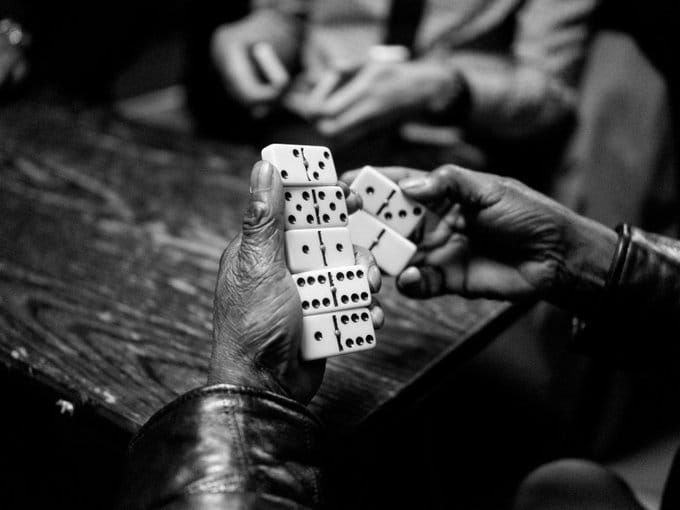
Four men sit around a worn table playing dominoes. One reaches for a bone without hesitation. Another studies the layout in silence, turning possibilities over in his mind before committing himself. A third leans back in his chair, saying very little, watching everyone else more carefully than they realise. The table bears the scratches and marks of hundreds of games played long before I arrived. Nothing about the scene asks to be photographed. That is precisely what draws me to it.
A game of dominoes unfolds at its own pace. Nobody rushes the next move. Conversation comes and goes. Laughter breaks the silence before giving way to concentration once again. Every player studies the same table, yet each sees something slightly different. Everyone is trying to imagine the bones they cannot see, making the best decision they can with only part of the picture.
Photographing moments like this has never felt like documenting an event. It has always felt like paying attention to the quiet ways people inhabit the world when nobody is asking them to perform. Long before I understood why, I found myself drawn to ordinary rituals. Friends talking across a kitchen table. Someone waiting at a bus stop. Children inventing games with whatever happens to be lying nearby. The photographs rarely looked dramatic. They simply asked me to stay long enough for life to become visible.
When I made this photograph, I thought I understood why I liked it. I didn't know I would spend years looking at it before I really saw it.
The waiting photograph
When I first edited the photograph, I thought I understood it.
It was the kind of picture I was always hoping to make. Nothing dramatic had happened. No decisive moment announced itself. The photograph simply observed a group of men absorbed in the quiet concentration of an ordinary domino game. I liked its restraint. It trusted the viewer to spend time with it.
For years, that was enough.
The photograph found its place among others I had made. Occasionally I returned to it while preparing an exhibition or revisiting older work. Each time I admired the same things. The worn tabletop. The hands. The concentration. The way every face remained just outside the frame, allowing the gestures to carry the conversation instead. I believed I understood what the picture was about because I remembered the afternoon I had made it.
The strange thing about photographs is that they are far more patient than we are. They do not change while they wait.
They simply remain where we left them, quietly gathering meanings we cannot yet see. The picture I had made that afternoon was always the same photograph. The only thing still changing was the person who kept returning to look at it.
At the time, I had no reason to think it would become one of the most important photographs I had ever made.
Practice
The diagnosis itself took only a few moments. The conversations that followed did not.
Almost overnight, my calendar filled with appointments. Blood tests were followed by a scan. The scan was followed by a biopsy. Every consultation introduced another word I had never expected to learn, and before long I found myself speaking a language I had never wanted to understand. Medicine has to work that way. It measures, compares and categorises because lives often depend on precision. I remain deeply grateful for the people whose knowledge and care now shape so much of my future.
Life outside the hospital carried on exactly as it always had. People hurried to work. Children filled the parks after school. Cafés welcomed the same familiar faces. Friends talked about football, holidays and politics. Nothing appeared to have changed. Only my way of seeing had.
Some time afterwards, I found myself looking through older photographs. I wasn't searching for anything in particular. I simply stopped when I reached the domino picture. I had looked at it dozens of times before. his time, I saw a different photograph.
For years I had admired it because it felt truthful. It captured a familiar scene with the kind of quiet attention I have always hoped my photographs might possess. I had thought the picture was about community, ritual and the ordinary grace of people sharing an afternoon together. It still was. But it was about something else as well. For the first time, I found myself looking not at the men but at the game itself.
Nobody around that table knows what everyone else is holding. Every player sees only part of the picture. Each move is made with incomplete knowledge, shaped by observation, experience and instinct. You study the table. You watch what has already been played. Then you place another domino, knowing that the game may change before your turn comes again.
Nobody around that table knows what everyone else is holding. Every player sees only part of the picture. Each move is made with incomplete knowledge, shaped by observation, experience and instinct. You study the table. You watch what has already been played. Then you place another domino, knowing that the game may change before your turn comes again.
The photograph hadn't changed. I had finally caught up with it.
So how do you live now?
The diagnosis did not make life uncertain. It revealed that it always had been.
For a while, I thought that realisation belonged only to illness. Gradually, I began to recognise it everywhere. Every ordinary day contains more uncertainty than we care to admit. We simply become accustomed to it. We make plans. We build routines. We mistake familiarity for permanence. The domino photograph reminds me otherwise.
When I look at it now, I no longer admire it simply because I think it is a successful picture. I return to it because it continues to ask something of me. It reminds me that photographs are never finished on the day they are made. They continue to gather meaning as we continue to live. Sometimes the most important photograph in your archive is not the one you thought it was. Sometimes it is the one that quietly waits until experience teaches you how to read it. That has changed the way I work.
I find myself drawn more than ever to the ordinary. A conversation over coffee. Children inventing games in the street. Friends talking around a kitchen table. A moment of quiet before someone speaks. They are not dramatic pictures, and they are not trying to be. I have learned to trust that quiet photographs sometimes take years to reveal what they have been saying all along. Perhaps people are much the same.
We rarely understand one another completely in a single conversation, just as we rarely understand a photograph in a single viewing. Both ask us to return. To look again. To notice what we missed the first time.
I still come back to the domino picture. The men are still gathered around the same table. The bones are still held in the same hands. The next move has still not been played. Neither has mine.
A personal note
I had few symptoms when I was diagnosed with prostate cancer.
If you're Black, over 45, or have a family history of the disease, please don't wait for symptoms to appear. Take 30 seconds to answer four simple questions using Prostate Cancer UK's free Risk Checker.